Ever since I witnessed Holland win their first ever international title in 1988, being a fan of the Oranje has been nothing but heartbreaks and bitter disappointments. With the Oranje not being part of the 24 teams playing this summer in France for the European Championship, let’s revisit their previous disappointments in this tournament since 1988.
The Lead-Up:
Two years after losing to Brazil in the Semi-Finals of the 1998 World Cup, the Oranje were back in the UEFA European Championship. This was their second consecutive elimination in a World Cup at the hands of Brazil. What made this exit painful was that their elimination came through a penalty shootout. This was the third time the Oranje had been eliminated by a penalty shootout this decade after Euro 92 and Euro 92. Manager Guus Hiddink stepped down after the World Cup and he was replaced by his assistant, the legendary Frank Rijkaard, who last played for the Oranje at World Cup 1994.
Holland and Belgium were the co-hosts for the 2000 edition. Thus, Holland did not have to go through qualifiers. However, they play in many friendlies to get ready for this tournament. They faced Croatia, Peru, Ghana and Germany in 1998. In 1999, Holland then faced Portugal, Argentina, Morocco, Denmark, and Belgium in a 5-5 draw in Holland, and Czech Republic. That year also saw them face Brazil three times, with the first two friendlies taking place in Brazil and the last one in Holland. In 2000, the Oranje faced Germany, Belgium, Scotland, Romania, and Poland in preparation for Euro 2000. This was the first Euro tournament to feature Nike as Oranje’s kit maker, after they switched from Lotto following Euro 1996. Personally, I consider the 2000 Oranje home shirt as my all-time favorite Oranje shirt.
The team from 1996 was now mature and battle ready, following their impressive showing at World Cup 1998 in France. Edwin van der Sar was in goal with Michael Reiziger as the right back and Frank de Boer as one of the two centerbacks. Ignored in 1996, Jaap Stam was now the other key center back for the team, with Arthur Numan and Giovanni van Bronckhorst, as the team’s left backs. The midfield saw the return of those who featured in 1996 such as Cocu, Ronald de Boer, Edgar Davids, Clarence Seedorf, who missed the costly penalty against France in the 1996 shootout, and a healthy Marc Overmars. Boudewijn Zenden would also feature for the Oranje after getting his debut in 1998 World Cup. Dennis Bergkamp and Patrick Kluivert would be the dynamic duo to lead the attack.
Defenders Bert Konterman Paul Bosvelt made their Oranje tournament debut in Euro 2000 along with the young striker Roy Makaay. Another player who was supposed to feature for the Oranje was Ruud van Nistelrooy but he would miss out after suffering a serious cruciate ligament injury. Thus, Pierre van Hooijdonk and Peter van Vossen were called up. The former got to play and scored in World Cup 1998 while the latter was representing the Oranje at a major tournament for the first time since World Cup 1994. Surprisingly, the lone holdover from Euro 88, Aron Winter, also made it on the team.
Group A consisted of defending European champions Germany, England, Portugal and Romania. Group B consisted of co-host Belgium, Italy, Sweden and Turkey. Group C consisted of Spain, Norway, Yugoslavia, and Slovenia, who was making its first ever debut in an international competition. Group D consisted of the co-hosts, Holland, France, the defending World Cup Champions and the team that eliminated them in Euro 96, Denmark, the team that eliminated the Oranje in 1992 Euro Semi-Finals, and Czech Republic.
Holland kicked off their Group A with an impressive 1-0 victory over the Czech Republic courtesy of a penalty kick scored by Frank de Boer in the 89th minute. The penalty was considered soft as Ronald de Boer’s shirt was being pulled inside the box by Jiří Němec, which affected Ronald’s chance of meeting Overmars’s cross. Holland then avenged their 1992 elimination by the Danes through an impressive 3-0 victory with Kluivert, Ronald de Boer and Zenden all scoring in the second half. Denmark could have pulled one back after van der Sar brought down Ebbe Sand inside the box in the 80th minute, but Michael Schjønberg missed from the penalty spot. After a slow start against the Czechs, this was a superb all-around performance by the Oranje.
Both France and Holland had won their first two group stage matches so the final group stage match would determine who would finish first and second in the group. Although France would rest the likes of Zidane, Lilian Thuram, Thierry Henry and others. Holland only rested the likes of van der Sar for Sander Westerveld, and Reiziger for Bosvelt, but the rest of the lineup was strong with Bergkamp and Kluivert up front. This was a classic match where France took the lead twice and Holland managed to comeback twice before winning it 3-2. Christophe Dugarry gave France the early lead before Kluivert equalized in the 14th minute. David Trezeguet scored France’s go ahead goal in the 31st minute to give France a 2-1 halftime lead. Holland got their equalizer in the 51st minute courtesy of a superb powerful free kick goal by Frank de Boer from quite some distance. Zenden then scored the game winner right around the hour mark to avenge the Quarter-Finals elimination by France in 1996.
Defending Euro 96 champions, Germany exited the group stage so a new champion was going to be crowned. Would Holland be celebrating on home soil with the Final taking place in Amsterdam? The Quarter-Finals had France facing Spain, Italy facing Romania, and Portugal facing Turkey.
Holland’s opponents in the Quarter-Finals would be Yugoslavia. Holland, destroyed, and some would say peaked, in this match that saw the Oranje crush their opponents 6-1. Kluivert scored a hat trick and Overmars scored a brace. Dejan Govedarica scored an own goal, which we thought was going to be Kluivert’s third originally before he would score again a few minutes later. Savo Milošević scored Yugoslavia’s consolation goal in stoppage time. Holland’s victory meant a Semi-Finals showdown with Italy while Portugal would face France.

The Heartbreak:
For those who watched this match, I apologize for making you relive this traumatic nightmare. For those who lucked out and never got to witness this match, consider yourselves lucky. Watching the highlights or full match now will never compare to witnessing this clash as it happened.
Holland lost two players to injuries prior to this match. Arthur Numan tore a muscle at the bottom of his right foot against Yugoslavia, which meant Giovanni van Bronckhorst would be the starting left back. Also, striker Roy Makaay tore a ligament in right ankle during training a few days before the Semi-Finals and would be out. Although Reiziger started the first two group stage matches as the right back, he was on the bench in place of Paul Bosvelt, who started against France and Yugoslavia. Stam and Frank de Boer anchored the middle of the defense. Overmars, Davids, Cocu and Zenden formed the midfield supporting the front two of Bergkamp and Kluivert.
Italy decided to play it safe and started a back five with the intent of sitting back just to counter-attack whenever the moment presented itself. There were far too many shots to list them all in this lookback but Holland were the dominant side from the opening whistle till the end. Just after three minutes, Bergkamp spotted a surging run from Philip Cocu and delivered a superb ball but Cocu’s final effort saw the ball fly over the bar. In the 14th minute, Bergkamp managed to get through on goal but his effort glided past Italy’s keeper Franseco Toldo, and struck the far post before bouncing away from the goal.
Italy were struggling with the Oranje attack and both Gianluca Zambrotta and Mark Iuliano were booked in the 15th and 16th minute respectively. In the 34th minute, Zambrotta would see red for his second bookable offense on Zenden and the Oranje were going to enjoy an extra man advantage for the remaining hour. In the 37th minute, Holland were awarded a penalty after Alessandro Nesta held back Kluivert inside the box. Frank de Boer stepped up to take the penalty against Toldo, who was only starting after first choice Gianluigi Buffon (Yes, him!) broke his hand in a friendly a few days before the tournament kicked off. Frank had converted against the Czechs in the opening group match but on this day, he could not. Toldo guessed correct as he dived to his left and denied the Oranje from taking the lead.
Holland lost their composure after that penalty miss and played lethargically till the half time whistle. Italy, down a man, opted to just sit back and defend. It was the classic “Parking the Bus” strategy before the term was made famous many years later. Holland kicked off the second half by being more patient, but that did not stop Italy from threatening when Stefano Fiore tested van der Sar with a shot on goal that was stopped and resulted in a corner kick. However, with chances hard to come by, the Oranje became scrappy and sloppy. Oranje’s resilience to find a way did pay off when they were awarded a second penalty after the hour mark.
In the 61st minute, Iuliano brought down Davids inside the box for the Oranje’s second penalty of the match. Surprisingly, the referee did not give Iuliano a second yellow. Nonetheless, Holland had a second chance at taking the lead. This time, Kluivert was going to take the penalty. Kluivert stepped up and made Toldo guess wrong, however, the ball hit the post and bounced out and Bergkamp’s effort on the rebound was wasted. Even Pele, watching in the stands, could not hide his disbelief in the penalty miss.
Holland would struggle for the remainder of the half to get another great chance. They were either shut down or fouled by the Italian players. In the 77th minute, Rijkaard made his first substitution by taking off Zenden and bringing on van Vossen, who did well in helping the Oranje with their offense. In the 86th minute, Rijkaard took off Bergkamp and brought on Seedorf. This was a sad substitution as it meant that this would be the final time Bergkamp would represent Holland if they lost to Italy. Bergkamp, at the age of 31, had announced he was going to retire from the national team at the conclusion of this tournament. A combination of his fear of flying and the fact that the next World Cup was going to be in Japan and South Korea made this decision possible. Although, Bergkamp endured criticism in the early stages of the tournament after being accused of not being effective enough, he performed remarkably in the 6-1 thrashing of Yugoslavia to silence such talk. It was a pity that he would bow out this way.
Remarkably, it was Italy’s substitute Marco Delvecchio who nearly won the game for Italy in stoppage time as he went past Frank de Boer before unleashing a shot on goal. Fortunately, his effort was right at van der Sar, which did not trouble the keeper. Italy also brought on Gianluca Pessotto and Francesco Totti off the bench to help deal with Oranje attacks. The full-time whistle blew and Holland had 30 minutes to score a golden goal and win it on home soil or endure another penalty shootout. Five minutes into Extra time, Rijkaard made his final substitution.
With Makaay and Numan out with injuries, depth became such an issue that World Cup 94 starting keeper, Ed de Goey, who was the team’s third keeper, had a spot on the bench besides the other backup keeper, Sander Westerveld. The rest of the bench consisted of Konterman, Ronald de Boer, van Hooijdonk, and Winter. Rijkaard opted to use his final substitution by taking off Cocu and bringing on Aron Winter. Many, including myself were surprised Ronald de Boer or van Hooijdonk were not brought on instead. This substitution was historic as it allowed Winter to make his 84th appearance for the Oranje and thus becoming, at the time, their all-time capped player. Some believe Rijkaard made this substitution was not made as a tactical reason, but as a token of gratitude, in order for his former teammate Winter to break the record as he neared the end of his playing career.
Italy almost ended the match with a golden goal ten minutes into extra time. A long ball played from the Italian box fell to Delvecchio. It was like reliving Bergkamp’s Argentina winner but fortunately, van der Sar made a superb stop to keep the game scoreless. Holland’s best chances fell to Seedorf and Kluivert, who both managed to fire across the goal and out of play. Neither side could end it with a golden goal so penalties would decide the outcome.
For both teams, the penalty box was hostile territory. Neither side had won a penalty shootout before, with Italy being eliminated in the 1980 European Championship and World Cups 1990, 1994 and 1998 by a penalty shootout. For the Oranje, this was their third straight Euro penalty shootout after 1992 and 1996, with memories of crashing out to Brazil two years before still fresh in their memories.
Italians went first, with Luigi Di Biagio, the man who missed the decisive penalty against France in World Cup 1998, to take the first penalty. Even though van der Sar guessed correctly by diving to his right, Di Biagio’s effort strong was powerful and out of his reach. Frank de Boer would take Holland’s first penalty. He had taken Holland’s first penalty against Brazil and converted from the spot. Unfortunately, his earlier miss must have weighed on his mind because his weak effort was easily dealt with Toldo. Pessotto made van der Sar guess wrong as he scored from the spot. Jaap Stam was the second penalty taker and sadly, his effort flew over the bar and probably out of Amsterdam Arena.
Holland was already down 0-2 in the shootout when the young Totti stepped up to take Italy’s penalty. Totti proceeded to score from the spot with a well taken “Panenka” that offered an early glimpse of his self-confidence that he would display to this day. Kluivert took Holland’s third penalty and he blasted his penalty to the right side of the goal, freezing Toldo in the process. Paolo Maldini proceeded to miss from the spot to give the Oranje a glimmer of hope. Sadly, Holland’s fourth penalty taker was another defender, Bosvelt. Toldo guessed correct by diving to his right and stopped Bosvelt’s tame effort and the party was over for Holland.
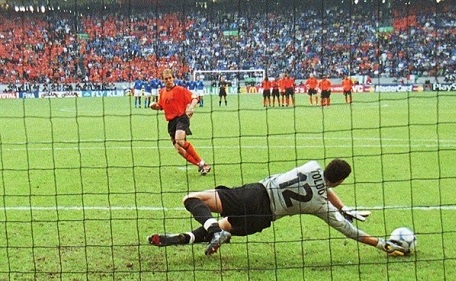
This was the Oranje’s fourth elimination in the last five tournaments by the means of a penalty shootout. The lone exception was their 3-2 1994 World Cup Quarter-Final exit to Brazil. Losses to Denmark in 1992, France in 1996, Brazil in 1998 and now Italy in 2000 was how the Oranje would be remembered in defeat. One has to wonder, with a team full of attackers, how was it that the majority of the penalty takers were defenders. Would it have helped if Ronald de Boer or van Hooijdonk came in place of Winter as the team’s final substitution?
Ultimately, this was a painful elimination with a lot of what ifs. Just like 1992, it was a bitter elimination from a tournament that was theirs to lose. Overall, this was entertaining showing by the Oranje with memorable performances along the way before their most painful exit in memory.

The Aftermath:
This was a heart wrenching loss for many Oranje fans, including myself. Holland did everything right except get the ball into the goal. Final stats would show Holland had 65% of possession, 21 shots with 8 of them on goal. Sadly, their poor finishing and penalties caused them to miss the party that was in their back yard. Dennis Bergkamp had this to say afterwards, “Stupid. So stupid. We only have ourselves to blame. I don’t know why Holland can’t win a penalty shoot-out.”
A few days later, Italy would end up losing 2-1 to France in their own heart breaking fashion in the same stadium that they eliminated Holland. Thus, France were now World Cup and European champions. After this heart breaking exit, Rijkaard stepped down from the Oranje and Luis van Gaal would become the new Oranje manager. This would be the last time we would see Winter and Bergkamp represent the Oranje in a major tournament. The majority of these players would continue to represent the Oranje, albeit in disappointing fashion. Under van Gaal, Holland failed to qualify for the 2002 World Cup and miss out on the important tournament for the first time since 1986.